Scuba regulators have come a long way since the days of the old double hose design of the 1950’s. Today even the low budget units breathe with far less effort than the best of the old time regulators. Modern regulators have gotten good, really good. Space age materials, computer numerical machining, and modern manufacturing techniques have done wonders for breathing performance, reliability, and maintainability. Aside from these major advances, probably the two things that have helped improve regulators the most in recent years are the European CE Directives, which mandates performance testing, and engineering test standards. Also, the wide spread use of the ANSTI breathing simulator, which allows manufacturers to precisely test and analyze the equipment being developed by removing much of the guess work and extensive prototyping.
In a perfect world, the amount of effort required to breath from a scuba regulator during a dive would be no greater than breathing on land without a regulator. However, it is not a perfect world. During a dive, the increased density of the breathing gas due to the water pressure and the energy required to activate gas flow, and keep it flowing, as well as the energy required to force the exhalation gas out into the water makes the amount of effort to breathe underwater far greater than on the surface. In the early years of regulator development, regulators were tested by simply using them. In the early years of open circuit the depth limit in the US Navy was set at 130 FSW primarily because of breathing performance and the lack of good breathing performance. To dive deeper than 130 FSW on a double hose was extremely risky.
In earlier years, only the US Navy had the sophisticated and expensive equipment needed to scientifically measure an breathing apparatus performance. The equipment and system(s) were far too expensive for manufacturers and the personnel with the required skills to conduct the testing were rare. In the world of sophisticate unmanned performance testing, the Navy reigned supreme. From the 1970’s to the mid 1990’s, Navy testing put pressure on manufacturers to improve performance. Manufacturer’s regulators that met the stringent Navy requirements had bragging rites and a shot at being placed on the coveted, Authorized for Navy Use List (ANU). Just having a regulator tested by the Navy was a valuable marketing tool for any manufacturer. Aside from spurring manufacturers to work harder to improve regulator performance, Navy testing did little to help in the engineering and development of scuba regulators. The Navy mission was / is not to develop equipment, but only to test and evaluate it for Navy suitability. The Navy unmanned test reports give work of breathing data, but do not make raw data available to the manufacturers. Additionally, the Navy considers their computer programs for work of breathing to be proprietary and does not allow manufacturers or non-government test facilities to share the software. This has made it difficult for manufacturers to improve equipment based on the Navy’s testing or test methods.
In the early 1990’s, things in the world of equipment testing started to change. A small engineering company, ANSTI, from outside Portsmouth, England introduced a specially designed, highly accurate test system designed for manufacturer’s development and testing. These ANSTI systems have become the world wide standard as far as test systems go. Equipment designers who do not have access to one find it very difficult to compete with those that do. Because of these systems, not only has regulator performance gotten better, but also manufacturing reliability has been vastly improved.
How well a regulator performs is based on several primary factors including diving depth, breathing rate/tidal volume and the mechanical and flow characteristics of the regulator.
Diving Depth: The deeper the dive the denser the breathing gas resulting in a greater resistance in flow during both inhalation and exhalation.
Breathing Rate: Tidal Volume is the amount of gas moved in and out of the lungs with each breath. Combining the tidal volume and the number of breaths per minute (bpm) is known as Respiratory Minute Volume (RMV).
Mechanical and flow characteristics of the regulator includes:
- The ease of which the inlet valve cracks and allows the flow to start
- Smoothness of air delivery
- Keeping positive pressure to a minimum
- Low exhaust resistance
All these characteristics are a balancing act in the design of a regulator. To make a regulator perform well at the high breathing rates often causes a sacrifice in breathing performance at the lower, normal breathing rates.
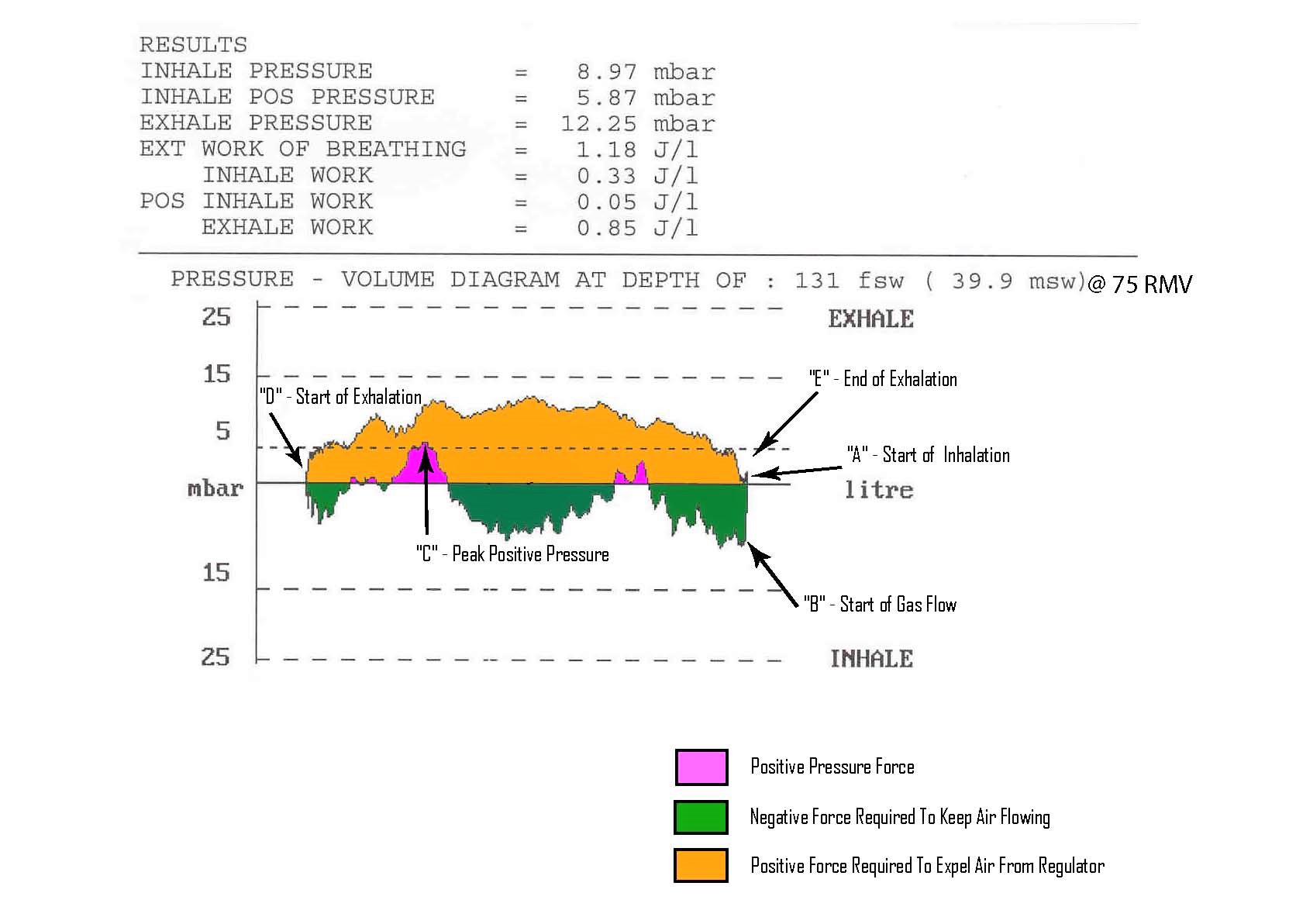
During inhalation, the effort required to start air flowing is called cracking effort. The cracking effort as well as the effort required to keep the gas flowing is inhalation effort. The ability of a diver to do heavy exertion is directly proportional to how well the regulator can supply and exhaust the breathing gas. As breathing resistance increases, the divers ability to work at higher exertion levels decreases.
The modern breathing simulator is a rigid, mechanical device integrated with pressure transducers and sensors linked to a computer. The highly sophisticated breathing simulator can mimic typical human breathing rates (breaths per minute) and volumetric displacement (lung volume). This breathing simulation is not exactly like human breathing, but it’s pretty close and does allow very accurate scientific measurements to be taken under controlled conditions. These measurements can be reliably duplicated at a later date with the same or other simulator systems.
The simplest way to visualize how a breathing simulator works is to think of a piston within a cylinder. The piston moves back and forth within the cylinder at a set distance known as the stroke. The piston diameter and stroke determine the volume displaced during one stroke. One stroke during inhalation and one stroke during exhalation make one complete breathing cycle. The stroke of the breathing machine can be adjusted according to the lung volume to be simulated and the number of strokes per minute can be increased or decreased to simulate the number of breaths per minute (bpm). Most breathing systems can be varied from 10 bpm to as much as 40 bpm. For European CE testing, the stroke used is 2.5 liters with a breathing rate of 25 bpm resulting in 2.5 liters X 25 bpm = 62.5 Respiratory Minute Volume (RMV). One half of the breathing cycle rate is inhalation and one half is exhalation. The complete cycle is known as the loop.
So how does this equate to a diver? Typically, the average fit male open circuit scuba diver can swim along at a moderate work rate of 35-40 RMV for at least five minutes. Military rebreather divers routinely swim long distances (1-2 miles) while maintaining 40-50 RMV. A scuba diver moving slowly taking in the scenery may take about 15-20 (bpm) and the breathing volume will average between 1.5 to 2.5 liters. For breathing simulator-testing purposes, if the breathing rate is 10 to 20 (bpm) a 2-liter tidal volume is normally used. For 25 bpm a tidal volume of 2.5 liters is normally used and for 30 bpm or greater, a tidal volume of 3.0 liters is normally used. Exactly how and why the actual volumes are used can vary according to the breathing characteristics being simulated. The ability to test over a wide range of volumes and rates allows the breathing simulator to identify the full capability of the equipment being tested.